 Add to Chrome
 Add to Firefox
 Add to Edge
Spatio-Temporal Correlation Guided Geometric Partitioning for Versatile Video Coding
Jun 01, 2026
Geometric partitioning has attracted increasing attention by its remarkable motion field description capability in the hybrid video coding framework. However, the existing geometric partitioning (GEO) scheme in Versatile Video Coding (VVC) causes a non-negligible burden for signaling the side information. Consequently, the coding efficiency is limited. In view of this, we propose a spatio-temporal correlation guided geometric partitioning (STGEO) scheme to efficiently describe the object information in the motion field of video coding. The proposed method can economize the bits consumed for side information signaling, including the partitioning mode and motion information. We firstly analyze the characteristics of partitioning mode decision and motion vector selection in a statistically-sound way. Based on the observed spatio-temporal correlation, we design a mode prediction and coding method to reduce the overhead for representing the above mentioned side information. The main idea is to predict the STGEO modes and motion candidates that have higher selection possibilities, which can guide the entropy coding, i.e., representing the predicted high-probability modes and motion candidates with fewer bits. In particular, the high-probability STGEO modes are predicted based on the edge information and history modes of adjacent STGEO-coded blocks. The corresponding motion information is represented by the index in a merge candidate list, which is adaptively inferred based on the off-line trained merge candidate selection probability. Simulation results show that the proposed approach achieves 0.95% and 1.98% bit-rate savings on average compared to VTM-8.0 without GEO for Random Access and Low-Delay B configurations, respectively.

Edge-directed geometric partitioning for versatile video coding
Jun 01, 2026To improve the coding performance, geometric partition (GEO) was proposed for the upcoming VVC standard. GEO provides 140 partition candidates. The index of optimal GEO mode needs to be signaled explicitly. Considering different structural characteristics of different CUs and the correlation between spatial adjacent blocks and temporal collocated blocks, we propose a GEO mode prediction strategy by constructing a Most Probable Mode (MPM) list to reduce the overhead of GEO index and improve coding efficiency. Based on the observation of the high correlation between the partition mode and object boundaries, an edge-directed geometric partition scheme is proposed to construct the MPM list according to spatio-temporal edge information. The proposed method provides an objective BD-rate gain of 0.58% and 1.00% on average for RA and LDB configurations compared to VTM-6.0. Besides, it also promotes the visual quality of object boundaries.
* This paper has been published in IEEE ICME
Deformable Wiener Filter for Future Video Coding
Jun 01, 2026In-loop filters have attracted increasing attention due to the remarkable noise-reduction capability in the hybrid video coding framework. However, the existing in-loop filters in Versatile Video Coding (VVC) mainly take advantage of the image local similarity. Although some non-local based in-loop filters can make up for this shortcoming, the widely-used unsupervised parameter estimation method by non-local filters limits the performance. In view of this, we propose a deformable Wiener Filter (DWF). It combines the local and non-local characteristics and supervisedly trains the filter coefficients based on the Wiener Filter theory. In the filtering process, local adjacent samples and non-local similar samples are first derived for each sample of interest. Then the to-be-filtered samples are classified into specific groups based on the patch level noise and sample-level characteristics. Samples in each group share the same filter coefficients. After that, the local and non-local reference samples are adaptively fused based on the classification results. Finally, the filtering operation with outlier data constraints is conducted for each to-be-filtered sample. Moreover, the performance of the proposed DWF is analyzed with different reference sample derivation schemes in detail. Simulation results show that the proposed approach achieves 1.16%, 1.92%, and 2.67% bit-rate savings on average compared to the VTM-11.0 for All Intra, Random Access, and Low-Delay B configurations, respectively.
* This paper has been published in IEEE Transactions on Image Processing
SRNeRV: A Scale-wise Recursive Framework for Neural Video Representation
Mar 09, 2026Implicit Neural Representations (INRs) have emerged as a promising paradigm for video representation and compression. However, existing multi-scale INR generators often suffer from significant parameter redundancy by stacking independent processing blocks for each scale. Inspired by the principle of scale self-similarity in the generation process, we propose SRNeRV, a novel scale-wise recursive framework that replaces this stacked design with a parameter-efficient shared architecture. The core of our approach is a hybrid sharing scheme derived from decoupling the processing block into a scale-specific spatial mixing module and a scale-invariant channel mixing module. We recursively apply the same shared channel mixing module, which contains the majority of the parameters, across all scales, significantly reducing the model size while preserving the crucial capacity to learn scale-specific spatial patterns. Extensive experiments demonstrate that SRNeRV achieves a significant rate-distortion performance boost, especially in INR-friendly scenarios, validating that our sharing scheme successfully amplifies the core strengths of the INR paradigm.
Video Compression with Hierarchical Temporal Neural Representation
Jan 25, 2026Video compression has recently benefited from implicit neural representations (INRs), which model videos as continuous functions. INRs offer compact storage and flexible reconstruction, providing a promising alternative to traditional codecs. However, most existing INR-based methods treat the temporal dimension as an independent input, limiting their ability to capture complex temporal dependencies. To address this, we propose a Hierarchical Temporal Neural Representation for Videos, TeNeRV. TeNeRV integrates short- and long-term dependencies through two key components. First, an Inter-Frame Feature Fusion (IFF) module aggregates features from adjacent frames, enforcing local temporal coherence and capturing fine-grained motion. Second, a GoP-Adaptive Modulation (GAM) mechanism partitions videos into Groups-of-Pictures and learns group-specific priors. The mechanism modulates network parameters, enabling adaptive representations across different GoPs. Extensive experiments demonstrate that TeNeRV consistently outperforms existing INR-based methods in rate-distortion performance, validating the effectiveness of our proposed approach.
Frequency-aware Neural Representation for Videos
Jan 25, 2026Implicit Neural Representations (INRs) have emerged as a promising paradigm for video compression. However, existing INR-based frameworks typically suffer from inherent spectral bias, which favors low-frequency components and leads to over-smoothed reconstructions and suboptimal rate-distortion performance. In this paper, we propose FaNeRV, a Frequency-aware Neural Representation for videos, which explicitly decouples low- and high-frequency components to enable efficient and faithful video reconstruction. FaNeRV introduces a multi-resolution supervision strategy that guides the network to progressively capture global structures and fine-grained textures through staged supervision . To further enhance high-frequency reconstruction, we propose a dynamic high-frequency injection mechanism that adaptively emphasizes challenging regions. In addition, we design a frequency-decomposed network module to improve feature modeling across different spectral bands. Extensive experiments on standard benchmarks demonstrate that FaNeRV significantly outperforms state-of-the-art INR methods and achieves competitive rate-distortion performance against traditional codecs.
MSNeRV: Neural Video Representation with Multi-Scale Feature Fusion
Jun 18, 2025Implicit Neural representations (INRs) have emerged as a promising approach for video compression, and have achieved comparable performance to the state-of-the-art codecs such as H.266/VVC. However, existing INR-based methods struggle to effectively represent detail-intensive and fast-changing video content. This limitation mainly stems from the underutilization of internal network features and the absence of video-specific considerations in network design. To address these challenges, we propose a multi-scale feature fusion framework, MSNeRV, for neural video representation. In the encoding stage, we enhance temporal consistency by employing temporal windows, and divide the video into multiple Groups of Pictures (GoPs), where a GoP-level grid is used for background representation. Additionally, we design a multi-scale spatial decoder with a scale-adaptive loss function to integrate multi-resolution and multi-frequency information. To further improve feature extraction, we introduce a multi-scale feature block that fully leverages hidden features. We evaluate MSNeRV on HEVC ClassB and UVG datasets for video representation and compression. Experimental results demonstrate that our model exhibits superior representation capability among INR-based approaches and surpasses VTM-23.7 (Random Access) in dynamic scenarios in terms of compression efficiency.
Generative Models in Computational Pathology: A Comprehensive Survey on Methods, Applications, and Challenges
May 16, 2025Generative modeling has emerged as a promising direction in computational pathology, offering capabilities such as data-efficient learning, synthetic data augmentation, and multimodal representation across diverse diagnostic tasks. This review provides a comprehensive synthesis of recent progress in the field, organized into four key domains: image generation, text generation, multimodal image-text generation, and other generative applications, including spatial simulation and molecular inference. By analyzing over 150 representative studies, we trace the evolution of generative architectures from early generative adversarial networks to recent advances in diffusion models and foundation models with generative capabilities. We further examine the datasets and evaluation protocols commonly used in this domain and highlight ongoing limitations, including challenges in generating high-fidelity whole slide images, clinical interpretability, and concerns related to the ethical and legal implications of synthetic data. The review concludes with a discussion of open challenges and prospective research directions, with an emphasis on developing unified, multimodal, and clinically deployable generative systems. This work aims to provide a foundational reference for researchers and practitioners developing and applying generative models in computational pathology.
UAR-NVC: A Unified AutoRegressive Framework for Memory-Efficient Neural Video Compression
Mar 04, 2025Implicit Neural Representations (INRs) have demonstrated significant potential in video compression by representing videos as neural networks. However, as the number of frames increases, the memory consumption for training and inference increases substantially, posing challenges in resource-constrained scenarios. Inspired by the success of traditional video compression frameworks, which process video frame by frame and can efficiently compress long videos, we adopt this modeling strategy for INRs to decrease memory consumption, while aiming to unify the frameworks from the perspective of timeline-based autoregressive modeling. In this work, we present a novel understanding of INR models from an autoregressive (AR) perspective and introduce a Unified AutoRegressive Framework for memory-efficient Neural Video Compression (UAR-NVC). UAR-NVC integrates timeline-based and INR-based neural video compression under a unified autoregressive paradigm. It partitions videos into several clips and processes each clip using a different INR model instance, leveraging the advantages of both compression frameworks while allowing seamless adaptation to either in form. To further reduce temporal redundancy between clips, we design two modules to optimize the initialization, training, and compression of these model parameters. UAR-NVC supports adjustable latencies by varying the clip length. Extensive experimental results demonstrate that UAR-NVC, with its flexible video clip setting, can adapt to resource-constrained environments and significantly improve performance compared to different baseline models.
Spatial Degradation-Aware and Temporal Consistent Diffusion Model for Compressed Video Super-Resolution
Feb 12, 2025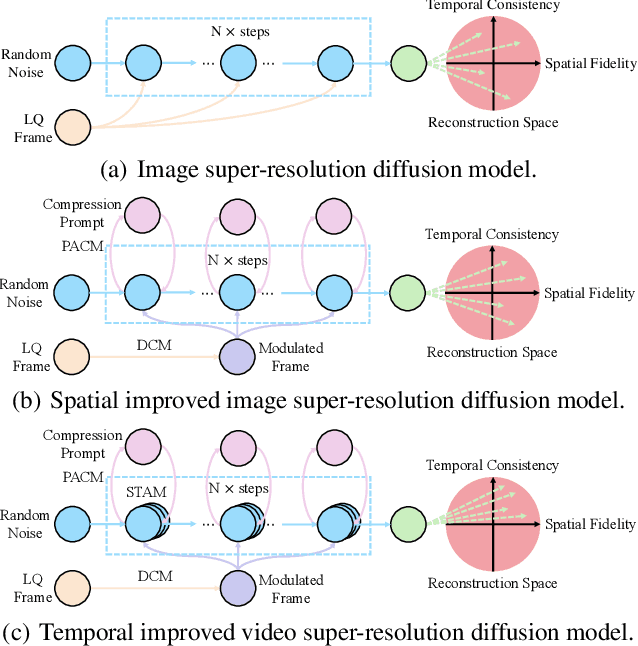
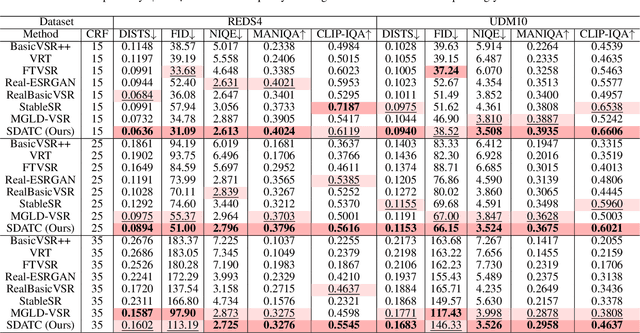
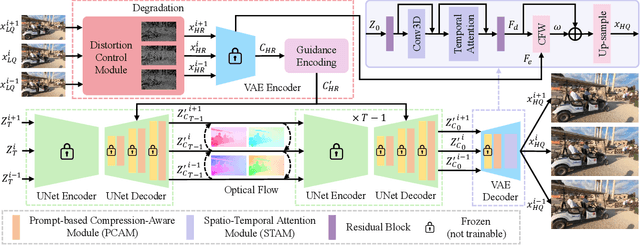
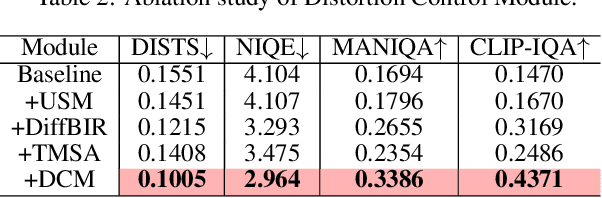
Due to limitations of storage and bandwidth, videos stored and transmitted on the Internet are usually low-quality with low-resolution and compression noise. Although video super-resolution (VSR) is an efficient technique to enhance video resolution, relatively VSR methods focus on compressed videos. Directly applying general VSR approaches leads to the failure of improving practical videos, especially when frames are highly compressed at a low bit rate. Recently, diffusion models have achieved superior performance in low-level visual tasks, and their high-realism generation capability enables them to be applied in VSR. To synthesize more compression-lost details and refine temporal consistency, we propose a novel Spatial Degradation-Aware and Temporal Consistent (SDATC) diffusion model for compressed VSR. Specifically, we introduce a distortion Control module (DCM) to modulate diffusion model inputs and guide the generation. Next, the diffusion model executes the denoising process for texture generation with fine-tuned spatial prompt-based compression-aware module (PCAM) and spatio-temporal attention module (STAM). PCAM extracts features to encode specific compression information dynamically. STAM extends the spatial attention mechanism to a spatio-temporal dimension for capturing temporal correlation. Extensive experimental results on benchmark datasets demonstrate the effectiveness of the proposed modules in enhancing compressed videos.